They say rivers remember. Long after kings are forgotten and palaces turn to dust, the river flows—carrying the stories of those who had no scrolls, no copper plates, no songs in their name. I am one such story. I am Sundari, daughter of Raji and Mallaya, born in the dry village of Nandagiri, where women rose before the sun and sang while scrubbing cloth against stone. My mother’s hands smelled of ash and wet cotton. I used to follow her to the stream, helping fold saris still warm from the midday sun. But when she died, the stream dried up for me too. I was just a girl. My father couldn’t manage alone. So I was sent away—to live with my aunt Akkamma, in a place I had only heard of in market gossip. Tagara. A town of bullock carts and trader caravans. Of endless cloth—dyed, folded, weighed, sold. A place where fine silks from Paithan and spices from the south passed through hands like my aunt’s. The Godavari runs close, and its riverbanks became my new world. We are Rajaka—washer folk. Our caste, our work, our silence—all passed down like a river stone from hand to hand. I started as a helper folding, carrying water, cleaning up. I watched older women scrub cloth till their hands bled. When I turned twelve, I was handed my first basket and told to go to the river. Since then, my days begin and end with water, silence, and sun. The world remembers Gautamiputra Satakarni, the great king whose name is carved in caves and copper plates. They speak of his victories, his gifts to monks. But no one remembers me, or women like me. Yet we are here scrubbing away the sweat and blood of a kingdom that never speaks our names. And yet, here we are cleaning the sweat and blood of a kingdom that never speaks our names.
The day starts when the sky is still ink blue. My husband, like most laborers, leaves early to dig, plough, or carry whatever the landlord demands. I gather the basket of clothes left at our doorstep by merchant households and Brahmin widows. Some are heavy with stains, others fine silks worn only once.
As I walk to the river, the town is still except for the sound of dogs, and the bells from the temple. But the bells are not for me. I cannot enter. I leave my own prayer beside a rock under the banyan tree, hoping the goddess hears even those who wait outside
The Godavari is both my workplace and my companion. The water is cold in the morning, numbing my fingers as I scrub. By midday, the stones burn my skin. I often wonder how can so much devotion, so many temple flags and sacred threads, exist in a place that calls my hands impure?
I am never alone by the river. The Godavari is more than water she is witness, refuge, memory. Along her banks, we gather: a quiet sisterhood of bent backs and sun darkened skin. We do not speak much, but in our glances, in the rhythm of our work, there is understanding deeper than any chant from temple towers.
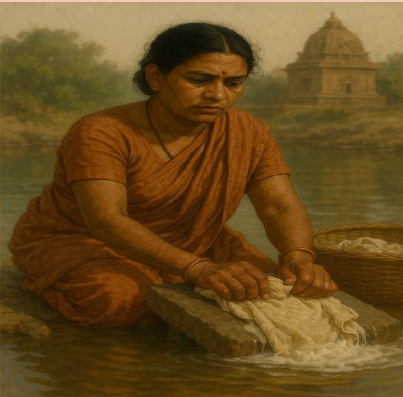
Mira folds cloth as she tells of her granddaughter’s laughter a bright spark she hopes will not fade into this cycle. Parvati, older than the fig tree, hums a tune that her mother once sang when hunger gnawed. Lakshmi, always silent, works with such steady grace that it seems the river flows to her rhythm. Caste is the water we wash in invisible to some, but always clinging to us. We do not name it. We do not curse it. We carry it, soaked into our saris, heavy as the cloth we haul home. We cleanse blood from bandages after battles we did not fight. We scrub turmeric from wedding silks we did not wear. We purify shrouds for the dead, though no one asks who washed the washerwoman when her own mother died. There are no thanks. No garlands. Just the next bundle. But the river sees us. And in her eternal flow, perhaps she remembers what the scrolls forget.
Since my earliest days, I’ve been taught to walk small not just in steps, but in presence. To lower my eyes not because I was shy, but because looking too long could mean trouble. I was taught that my voice should be soft, my thoughts kept inside, and my hands always busy Once, a Brahmin boy kind eyed and curious asked me my name. I answered with a whisper, thinking nothing of it. By sunrise, his mother had scolded me in front of others. Your name, she said, “is not fit to reach the ears of the learned.” That day I learned that even my identity was something I had to hide. Not just my voice, but my very name. Since then, I’ve spoken less. But silence is a vessel it holds the weight of every question I’ve never dared to ask. They call it Dharma, this order we are bound to. But this Dharma was never written with my hands, nor spoken in my tongue. It is a Dharma that carves gods in stone, but cannot carve dignity into the lives of women like me.
So, I ask, in the quiet of my heart: whose Dharma is this? And why must it chain some of us so others may float?
By midday, the sun is harsh. I return home carrying the same basket, now empty, my arms and shoulders sore. My children two daughters and a small boy wait for food. I boil rice, water it down to stretch it. I mash lentils, pick out stones. I smile, but I count every grain. My hands ache not just from the river, but from worry will we have enough to give the temple priest his due? Will the tax collectors come before the harvest ripens?
My husband speaks little these days. He is tired of selling labor for grain and still owing more. He says merchants thrive, gold passes through Tagara like a river of its own yet none of it ever touches our hut. I’ve seen Roman coins in market stalls, but in our house, we barter soap for grain, or a shawl for a piece of broken copper. Sometimes I hear that the town thrives because of us that the washerfolk, potters, and weavers are the backbone of its trade. But spines bend. And mine is already beginning to curve. My Radha my elder daughter, curious and bright, begs to come with me to the river. I stroke her hair and whisper, look at the sky, count the birds, remember the names of every tree. Your world must be wider than mine. Yet, in my heart, I know no girl from our caste has ever broken free from this cycle. Still, I hope.
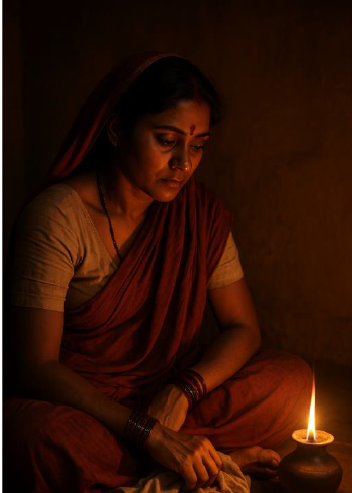
They speak of Nāganikā, the queen who ruled with wisdom, who left her voice in stone at Naneghat. They remember her strength. Her name stands beside kings. I, too, have strength. But it is not draped in silk or carved in caves. It is silent, wet, cracked, and constant. It is shaped in the rhythm of work, in the way I carry my basket, in the way I do not let grief undo me. Each night, I light a lamp and whisper to the wind. I do not ask for gold or fame. I ask for resilience for Radha to one day speak in halls where I could not. For my son to lift baskets that are not soaked in shame. I dream of a world where our names are not only remembered, but spoken with dignity not as footnotes, but as foundations.
Tomorrow, I will rise again before the sun. My feet will find the path to the river, as they always have. But in my heart, I carry the hope that my daughter’s path may one day lead beyond the riverbank.
Until then, I endure.
Time Period: Satavahana Dynasty (c. 1st 3rd century CE), dominant in South India.
Caste Context: The Rajaka (washerman) caste is mentioned in the Manusmriti and in inscriptions from the Satavahana and later periods as a hereditary service caste.
Gautamiputra Satakarni and Nāganikā are documented rulers, with Nāganikā leaving a Prakrit inscription in Brahmi script at Naneghat.
Women of Shudra castes had no temple access or formal education rights, though they had rich oral traditions.
Tagara: Identified in the Periplus of the Erythraean Sea as a major inland trade center connected to the Roman maritime trade route.
The Satavahana period saw urban rural divide, caste rigidity, and unpaid labor by women in both religious and household contexts.