My name is not written in palm-leaf books, and no bards sing of my life. But every grain of salt that passes through my hands carries a story. I am a salt maker’s daughter from the Neithal land, the stretch of Tamilakam where the sea breathes its briny mist into our mornings and the sun hardens our backs by noon. This land is where the ocean meets the shore, and where my people, the Umanars, draw the earth’s white wealth from salt pans shaped by the hands of women like me.
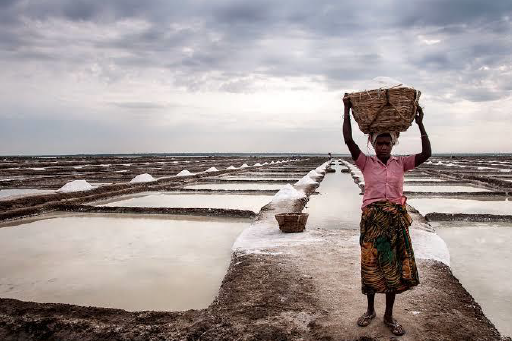
At dawn, we begin. The salt pans or uppalams, as we call them, stretch across the coastal plain like shallow mirrors of the sky. As the sun rises, we walk barefoot over crusty, sunbaked earth, our hands carrying rakes, baskets, and hope. My mother taught me how to read the sea, to know when the tide had brought in just enough water, and when to begin the work of drawing it out not with force, but with patience. The sun is both our partner and our judge. If it shines too fiercely, the pans crack. If clouds linger, the salt refuses to rise.
Salt, in its bitterness, is life to us. Though our skin stings and cracks from long hours in brine, we do not complain. My daughter, still small, hums as she counts the fishing boats returning to shore: “This is my father’s boat… this is your father’s boat…” It is how the children here learn to count and remember through sails, not slates.
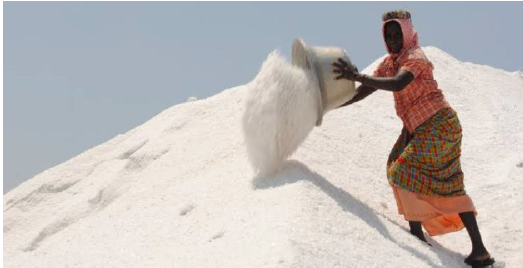
Though we are poor in land, our salt is rich in value. We do not trade with coins; here, we barter. Salt for paddy. Salt for fish. Salt for sugarcane, honey, ghee, and yams. Sometimes we get flattened rice or toddy in return. Our baskets of white crystal are carried inland in bullock carts, bouncing over roads through Marudham rice plains, through Kurinji hills, and into Mullai forests. We trade with those who’ve never seen the sea. They give us what we cannot grow, and in return, we give them what they cannot live without.
Paddy is most often what we receive, and it has become the closest thing to money in our land. Salt and paddy these two are the bones of our market. There are times when even workers are paid not in coins but in measures of rice and lumps of salt. The very words we use for wages today like sambalam carry the memory of salt, or “alam,” within them.
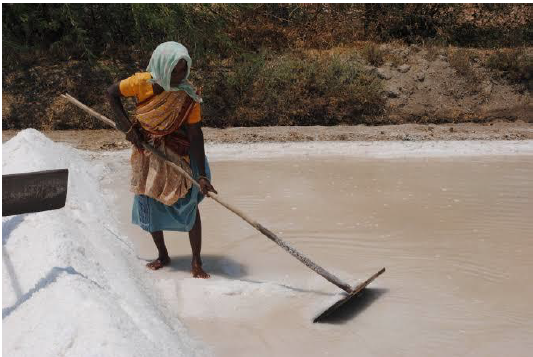
Our work is not isolated to women, but it is women who hold this world together when the men travel to trade. My father used to return with stories from distant villages: of forest honey hunters, of cowherds near sacred groves, and of rice fields so vast they seem to stretch into the sky. But now that he has grown old, the younger men go. My mother and I sell at the edge of the pans, our voices loud and firm in the market. Women like us may not stand in temples or lead rituals, but we know the art of negotiation. The men speak in long poems; we speak in weights and measures.
Though we are neither nobles nor Brahmins, our role in society is neither invisible nor dispensable. Our salt touches every caste, every table, every market. We are not adorned with fine jewels, but our sweat-seasoned work gives dignity to our name. The landowning Vellalars may have their ploughs and titles, but when they dine, it is our salt that seasons their food. The bards may praise warriors and kings, but without us, even kings cannot preserve their fish.
We live in close-knit coastal communities, our huts gathered near the salt pans and shores. We know which families own which boats, and when one does not return, the entire village grieves. Trade routes can be dangerous, robbers sometimes lie in wait. That is why salt traders travel in groups, forming caravan bands. These moving bands of traders connect us with faraway places and bring with them the stories of floods, droughts, and births in other lands.
Our belief is tied to the sea and the skies above it. The sea is not just a stretch of water it is a living force, sacred and terrifying. We leave simple offerings to Varunan, the lord of the ocean, hoping he keeps our men safe and our pans full. The rituals here are not elaborate. A garland, a bowl of milk, sometimes a pot of boiled rice left by the shore, these are our prayers. We do not have towering temples, but we live surrounded by the sacred. The sea, the sun, the land we worship them with every breath and every basket lifted.
Some say spirits live in neem trees, and I have seen families make offerings of curd and flowers beneath them. There are even rituals where cows are sacrificed to soothe angry spirits, though that practice is more common among warrior clans. We saltmakers do not often deal with such blood. Our religion is gentler less about fear, more about thanks.
My greatest fear is not death, it is a failed harvest. One season of untimely rain, and the salt pans flood. One strong storm, and the baskets are ruined. One greedy tax collector, and a family’s food is gone. Those who collect dues sometimes take more than is fair. We hide what we can, but hiding salt is harder than hiding grain, it glows under the sun like silver.
And yet, there are joys. The first crackling sound of salt forming, the laughter of children chasing each other between the pans, the songs sung by women as we work under the morning sky. There is pride too. When we walk into the market with our baskets, heads high and steps steady, people know we carry more than salt, we carry the coast’s lifeblood.
When I was a girl, I used to wonder if people in the cities would ever speak of us, if poets would ever sing of the women who bring the sea into the hands of the land. Now, as I grow older, I no longer need their poems. My story is written in each grain I carry. My name may fade, but the salt will remain.
We are the nameless hands behind every salted dish, every preserved fish, every traded grain. We are the women of the Neithal coast. We walk with salt on our skin and the sea in our hearts.