The scent of turmeric and blood and burning sandalwood has become my constant companion. I Somasena, a Vaidya in the service of Emperor Ashoka Maurya. My hands are trained not in the art of war, but in the science of healing. I studied the sacred texts of Charaka and Sushruta, learned to balance the doshas, and mastered the use of herbs and surgical tools. But nothing in my training prepared me for the horrors I would witness on the blood-soaked plains of Kalinga.
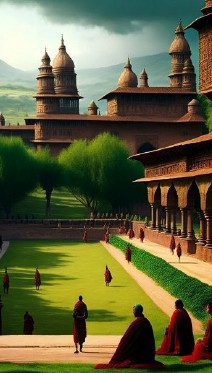
I was born in a well-known family of herbalists and healers in a small valley near Takshashila one of the most renowned centers of learning in the world. My father, a respected local Vaidya, taught me the basics of Ayurveda but it was my mother, a devoted laywoman, who gave me the values of compassion, non-violence, and mindfulness. In my early teenage, I was accepted into the Takshashila Mahavihara, where I studied under a master physician trained in Sushruta Samhita, the foundational text of surgery and medicine.
After years of practice my techniques refined and soon I became well known and this is the reason that when Mauryan Empire Began its campaign against Kalinga, I was summoned by the royal court to serve as a Battlefield physician along with other Vaidyas and a team of assistants. Though reluctant to participate in a war, we accepted the call, not to support conquest but to alleviate suffering. I believed that even in the heart of violence, a healer’s presence could be a form of resistance.
We left Pataliputra nearly two moons ago, marching eastward with the Emperor’s vast army. Kalinga, proud and defiant, has resisted Mauryan rule for generations. Now, Ashoka seeks to bring it under the imperial fold. I travel with a mobile Chikitsalaya—a makeshift healing station fashioned from bamboo and cloth. We carry bundles of Haridra (turmeric), Yashtimadhu (licorice), and guggul resin. Our surgical tools, modeled after the teachings of Sushruta, include scalpels, forceps, and cauterizing rods.
The first skirmishes erupted near the banks of the Daya River, once serene, ran red with blood. The Kalingan warriors are fierce and unyielding. Their archers strike with deadly precision, and their war elephants charge with terrifying force. Our soldiers fight bravely, but the cost is high. Each day, dozens of wounded are brought to our camp—some with limbs shattered by chariot wheels, others with arrows lodged deep in their flesh. We use banana leaves as bandages and boil neem water to cleanse wounds. When cloth runs out, we tear strips from our own garments. When pain overwhelms, we offer opium mixed with honey.
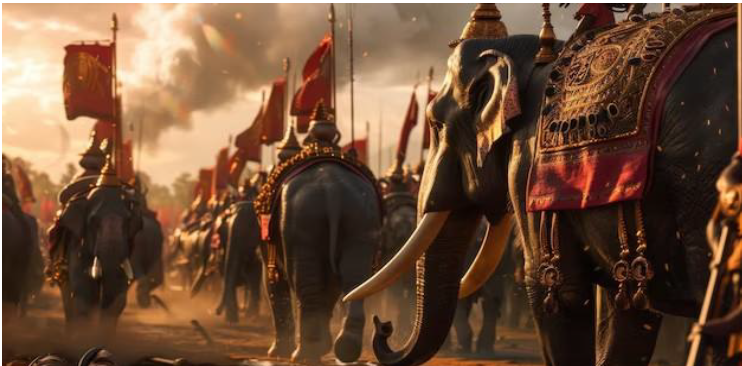
I performed my first battlefield amputation three days ago. A young soldier’s leg had been crushed beneath a fallen elephant. There was no saving it. I used a heated blade to cauterize the wound after the cut. He survived, but his eyes stared blankly at the sky, as if his soul had fled. I fear he may never return to the world of the living.
The battlefield is a place of chaos and contradiction. One moment, the clash of steel and the roar of elephants; the next, the quiet sobs of a dying man calling for his mother. I remember a Kalingan boy, no older than ten, brought to me with a spear wound. He was not a soldier—just a child caught in the storm. I tried to save him, but he died clutching a pebble in his hand. That night, I could not sleep.
The Emperor himself has arrived at the front. I saw him today, standing at top a hill overlooking the battlefield. His face was grim, his eyes fixed on the carnage below. He did not speak, but some saw his hands tremble. Rumors swirl among the soldiers—that Ashoka is disturbed by the scale of the bloodshed, that he has begun to question the cost of conquest. But the war continues. The Kalingans refuse to yield, and our forces press on.
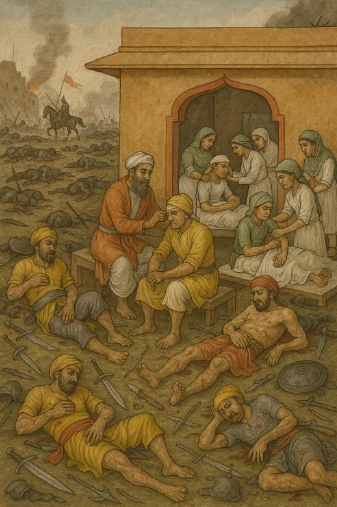
We have set up a more permanent Chikitsā laya near the river, using bamboo poles and palm leaves for shelter. The wounded lie in rows, moaning softly.
Some are Mauryan, others Kalingan. We treat them all. The teachings of Ayurveda do not distinguish between friend and foe. I apply sandalwood paste to burns, stitch gashes with horsehair thread, and chant mantras to calm the minds of the dying. A Buddhist monk from Nalanda has joined us, offering prayers and comfort. His presence brings a strange peace to the camp.
Our supplies are dwindling. The herbal stores we brought from Pataliputra are nearly exhausted. I have sent word to the rear guard, requesting more Haritaki, Ashwagandha, and Triphala. In the meantime, we forage for local herbs—neem, tulsi, and bhringraj. The land here is rich, but the war has scorched much of it. Fields lie fallow, villages abandoned. The people of Kalinga suffer as much as the soldiers.
I do not know who will win this war. The Kalingans fight with the desperation of those defending their homeland. Our army is vast and disciplined, but the cost is mounting. Each day brings new casualties, new grief. I see it in the eyes of the soldiers, in the silence that falls over the camp at dusk.
Today, a soldier named Viraj came to me with a deep wound in his side. As I cleaned and stitched it, he asked me, “Do you think the gods watch us, Vaidya? Do they see what we do?” I had no answer. I gave him a decoction of guggul and told him to rest. But his question lingers in my mind.
The Dhamma Mahamatras—officials appointed by the Emperor to oversee moral conduct—have begun visiting the camps. They speak of compassion, of duty, of the sanctity of life. Some scoff at their words, but I find comfort in them. Perhaps even in war, there is room for mercy.
I write this now as the sun sets behind the hills. The sky is streaked with red, as if the heavens themselves bleed. The cries of the wounded echo through the valley. I do not know what tomorrow will bring—more blood, more death, perhaps a glimmer of peace. But I will be here, with my herbs and my prayers, doing what I can to mend what war has broken.
I am Somasena, Vaidya of the Mauryan army. I do not wield a sword, but I fight in my own way—against pain, against despair, against the darkness that war brings. And though I do not know who will win this battle, I know that every life I save is a victory.