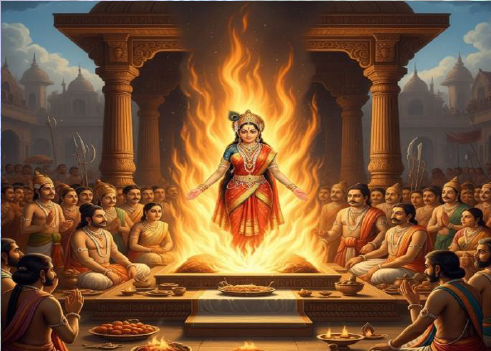
In the Sanskrit epic Mahabharata, Draupadi is a divine-born princess who was married to the five Pandava brothers because of fate, after Arjuna's victory in a swayamvara to get the hand of a princess. The story emphasizes her extraordinary beauty and the goodness of her character—she is said to be "fire-born" like the goddess Durga. Nevertheless, throughout the epic, her choices have been limited by the patriarchal society she lives in.
\
Vyasa depicts Draupadi incessantly as a mere pawn, who is always acted by men. Draupadi's polyandrous marriage is presented as a practical solution for preventing fratricidal conflict, Yudhishthira's bet that led to the loss of Draupadi's freedom, and the armies mobilized around the throne represent male domination. When in the court of Hastinapur, Duryodhana’s brother Dushasana tries to disrobe Draupadi, it is her appeal to Krishna—who is a male god and also her cousin—that saves her sari without a single thread being lost, thus highlighting her helplessness and her reliance on the protection of men.
In the event that Draupadi at risk of being violated by the guards after the game of dice vehemently exclaimed, "Who was lost first by Yudhishthira—himself or me?", it is however necessary to point out that these incidents take place when she is being oppressed and finally the help of God or the decisions of men are given. Therefore, to sum up, traditional narratives portray Draupadi, as a speaker and faithful, vibrant during moments of crisis, but inevitably passive in the face of male power.
On the other hand, folk and regional traditions present Draupadi from the Mahabharata as a strong, and even godly, heroine character. It is generally understood that local versions, mostly in South and East India, dwell upon women-focused tales. To be specific, in the Draupadi Amman cult of Tamil Nadu that is the Vanniyar community, she is a goddess who is ‘’mother, beautiful goddess’’, that one polishes the ‘’children’’, the Pandavas, hence the one that protects them, she is the one who is worshiped. Pujari songs, folk songs that are used for religious purposes, depict Draupadi not as an object of shame but as a loving fighter who often calls her the highest Shakti (primordial energy) and is triumphant over her fighting deeds. In the versions of the story, however, nasty scenes from here like the boiling pot (disrobing) are typically not introduced or changed significantly: thus, Draupadi in fact such a holy and martial as here, thus such a humiliation “does not work out for her stature.”
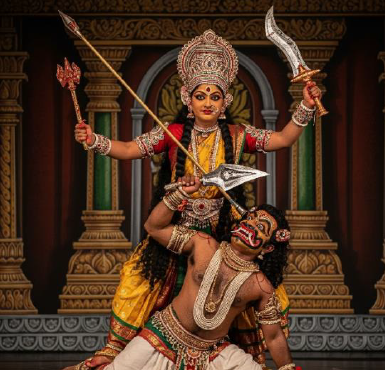
In the same way, in Karnataka’s Yakshagana theatrical art "Draupadi Pratāpa" is the most important play on her courage. One of the scenes gives an example of her changing into the war goddess Chandi after the defeat of Krishna and the Pandavas by a demon - she kills the demon Kaundinya by herself and brings back peace in the region. The Yakshagana goes into detail to “make sure the success of Draupadi” as a goddess and not “a normal woman.” Besides, performances of other types of folk theatre, for instance, Therukoothu and Bharatakottu, continue to tell the story of Draupadi and her characteristic full of ardour and energy.
Such illustrations reflect the major change that the male characters, in folk narratives, revolve around Draupadi, whereas in the Sanskrit epic, it is she who revolves around them. In many regional versions, Draupadi doesn’t have five husbands; they are secondary. Draupadi is depicted to be the cosmic center, the martial queen or goddess. For instance, the Tamil festivals represent her as Pāśupathagūna, the protector of village welfare. Significantly, the question of polyandry is no longer debatable: the communities that worship Draupadi as a goddess are those that also have polyandrous traditions, and thus her marriage to five brothers is accepted without the need to justify it. Hence, traits that the classical epic only suggests can be found in folklore—figures of righteous anger, magic power, and allegiance to honor.
Indeed, Draupadi is portrayed as a self-sacrificing heroine and a faithful consort who was originally created from fire in the Mahabharata Epic. She is the epitome of brightness and goodness, although her story narrates mainly the pains she has faced—i.e., the game of dice loss and exile—and her being dependent on others.
Most of the time in the classical epic, her insufficient voice is mainly in times of crisis, for example, at the dice court and the forest, while men decide the final outcome. Whereas Draupadi is depicted as a divine warrior and a beneficiary of humanity in a local context. For example, in Tamil, Draupadi Amman festivals, she is worshiped as Parasakti, the mother goddess of the village that provides a call to the women to re-supply the fertility and prosperity of the community. Folk plays often stress her independence, one such example is Yakshagana scripts where Draupadi is seen as a very calm person who keeps on bragging about her victories over the demons and challenging her husbands to become the winning ones. These images are the reflections of her fighting abilities, her spiritual power, and her good moral character. Significantly, the scene of the disrobing is barely mentioned or it is presented from a different perspective; most of the stories do not include the disrobing part at all, instead, Draupadi is portrayed as a kind and strong character who is in a fight rather than a passive one who is being victimized.
In the Sanskrit epic that is based on a male-dominated society, Draupadi is the personification of the perfect woman—courageous but chaste, deeply loyal but still obeying dharma and the male family. Her defiance of gender norms, such as calling out Duryodhana, is particularly dramatic because it disrupts expectations. On the other hand, the stories that folk tell, generally coming from matrilineal or less male-dominated kinds of societies, completely reverse this tale. The collective memory has changed in such a way that here Draupadi is not merely a wife of men, but a force of her own. She takes names like Virapanchali (bride of heroes) and Virāṅga (brave warrior) thus, the emphasis on her military freedom is still present.
Draupadi is the polyandrous goddess figure of the epic Mahabharata who is now being represented negatively and ironically in the context of polyandry that happened due to her reincarnation in the present time. One of the places where this is going on in the name of Draupadi is among the Jaunsari tribe in Uttarakhand. The tribe is known for its custom of one woman marrying all brothers of the same family which is a subconsciously recreation of Draupadi's marriage to the five Pandavas. The story of Draupadi as a legendary figure and the practice of polyandry are in two different worlds because, while the former is alive with glory and legend, the latter is a tale of exploitation and suffering that women are forced into. Women are becoming victims of emotional abuse, health hazards, and are losing their rights which are the examples of how the mythical characters are being replaced by the harsh realities of the modern women who find themselves in similar situations.
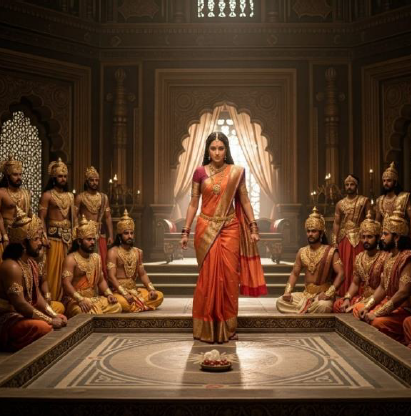
Many are the changes of the new version of the story of Draupadi that were made by modern personalities. Draupadi is now commonly portrayed by the media as a women empowerment figure. She’s now shown as a "fierce feminist standing her ground" against male violence, an "untamed woman" who "refuses to bow down to the questionable standards of patriarchal society." This fact reflects the ancient and new versions of her character, which is mostly acknowledging the new audiences' view of a woman who has been empowered. Without the system that "denies her justice," she "constantly demands equanimity," thus becoming the source of inspiration for gender activists. The change from victim to goddess ascribing the stories of Draupadi depicts a wider social revolution; as social values change, storytellers recast her story to emphasize autonomy over subservience.
To sum it up, there are deep differences in the ways Draupadi's agency is voiced in the epic versus the folk traditions. The Mahabharata recasts her as a dignified, albeit powerless, figure who is largely silent and whose fate is decided by male characters and gods. The folk traditions, on the other hand, present her in a very different light: she is the one who safeguards her family and the whole earth, the leader of warriors, and the one that the people are worshiping as Shakti. According to one scholar, "folk versions indeed grant Draupadi 'more space and importance,' frequently depicting her in forms that have 'little or no resemblance' to the classical Draupadi, aside from a few plot points" those characters.