What is time? Is it real, or merely a construct of human perception? While modern science especially Einstein’s general theory of relativity—views time as flexible, capable of stretching or shrinking depending on speed and gravity, the Indian tradition approaches time through a radically different lens. At its core is the Kalachakra, the Wheel of Time, which symbolizes the cycles of creation, maintenance, and destruction across vast cosmic spaces, encompassing gods and entire worlds. Long before modern science imagined such time scales, Indian seers observed the movements of celestial bodies, creating calendars that harmonized human life with the cosmos. Time was not abstract or separate, but a divine rhythm of life. To understand Indian cosmology, one must start with Kalachakra, where time is not a line but a sacred circle.
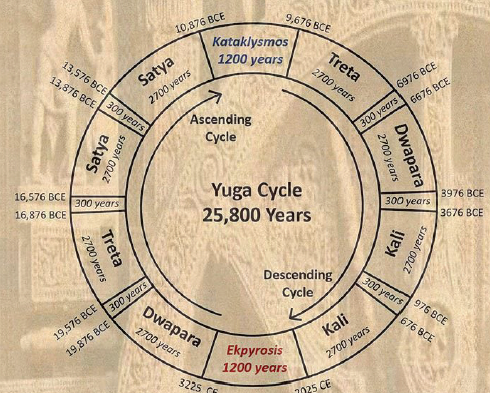
Indian cosmology sees time not as a linear progression but as a vast, repeating cycle, measured in staggeringly large units. This understanding challenges the dominant modern view, where time is seen as a straight path of progress — from past to future — with no return. In contrast, the Kalachakra shows a cosmic humility: even creation, gods, and universes are part of an ever-repeating cycle. In this vision, the future is not a break from the past, but its renewal. According to the Vishnu Purana (Book 1, Chapter 3) and the Bhagavata Purana (3.11), One Mahayuga, or basic cycle, comprises four yugas: Satya (1,728,000 years), Treta (1,296,000), Dvapara (864,000), and kali (432,000). Together, they form a mahayuga lasting 4.32 million human years. Seventy-one such Mahayuga constitute a Manvantara, the age ruled by Manu, the cosmic progenitor, spanning over 306 million years. Fourteen manvantaras, together with their transition periods (sandhyamas), make up a Kalpa, or day in the life of Brahma, lasting 4.32 billion years. Then follows a night of the same duration, during which the universe enters a state of rest (pralaya). Brahma's year comprises 360 such days and nights, and his entire life consists of one hundred such years: more than 311 trillion human years. Creation and destruction are repeated in every Kalpa. The cosmos is born, sustained, and continually merges into the unmanifest, without beginning or end. Even the deities follow this rhythm. In the current seventh manvantara, we are said to be ruled by Vaivasvata Manu, the son of the Sun-God, while Indra is ruled by Purandara. Significantly, Rama and Krishna are said to appear in this same cycle, suggesting that divine incarnations also follow a cosmic calendar. Even Brahma, the creator, is not free from the power of Time (Kala). At the end of his hundred-year lifespan, he too dissolves into the great Mahapralaya.
The Mahabharata (Shanti Parva 232.13) poignantly says,
“Time, which wears out everything, even the gods and Brahma, puts an end to everything.”
The cyclical nature of time in Indian thought fosters cosmic humility—reminding us that even gods and galaxies move within the wheel. Kalachakra is not just myth but a spiritual metaphor for karma, impermanence, and renewal. It teaches that all life carries responsibility, even divine beings are transient, and darkness will give way to light as Kali Yuga ends and Satya Yuga begins. More than cosmology, Kalachakra is a moral guide aligning human life with the universe’s eternal rhythm—lived through ritual precision and scientific insight in yajña and jyotiṣa.
In Indian civilization, time was not abstract but lived—woven into rituals, festivals, and cosmic rhythms. Unlike today’s focus on productivity, ancient India saw time as sacred and participatory. Yajña, the Vedic sacrifice, was a precise act of cosmic alignment, where every mantra and offering matched astronomical moments. Jyotisha (astronomy) guided daily life and worship, linking the spiritual and celestial.
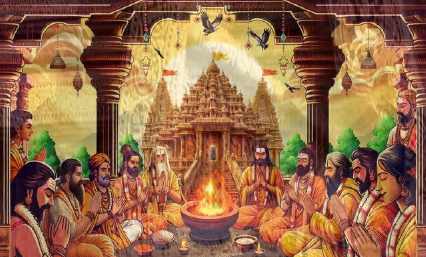
The Shatapatha Brahmana (11.1.6) states:
यो वै नित्यं अनिहोत्रं जुहोनि स कालः भवनि।
One who performs agnihotra daily at the appropriate moment becomes time itself.
Rituals were a way to merge with time. Their precision gave rise to Jyotisha-shastra, the Vedic science of astronomy. Vedāṅga-Jyotisha calculated solstices, equinoxes, lunar phases, and constellations to align rituals with cosmic rhythms.
The Yajur Vedanga Jyotisha (1.1) says
कालः जगिः बीजम्। यः कालं वेद स यज्ञं वेद।
Time is the seed of the universe. He who knows time, knows sacrifice.
Astronomy evolved to time rituals, not just study stars. Thinkers like Lagadha, Varāhamihira, and Āryabhaṭa built precise systems centuries before heliocentrism. Even governance followed time: kings were Kalachakrapuruṣas, aligned with the cosmic wheel. Misrule meant decline and the rise of Kali Yuga. The Purāṇas called the ideal ruler the Kalachakrapuruṣa—one who moves with time's wheel. If he erred, dharma declined and Kali Yuga began. Even in everyday life, the Indian calendar was a living embodiment of cosmic order. Festivals like Makara Sankranti, Navaratri, and Kumbha Mela mirrored celestial events, keeping society in sync with the cosmos. Time shaped not just metaphysics but ethics seen not as scarce or linear, but as divine, cyclical, and abundant.
The Bhagavad Gita says
कालोऽस्मि लोकक्षयकृि् प्रवृद्धो
I am Time, the destroyer of worlds” (Gita 11:32).
In Indian thought, time is not neutral but divine and transformative — a sacred wheel, not a clock. To live rightly is to align with it, not control it — to participate in cosmic rhythm, not just pass time.
While early Indian traditions aligned with ritual time, later philosophies sought to transcend it. Schools like Yoga, Advaita Vedānta, Shaivism, and Tantra explored time's deeper nature—questioning its reality and seeking liberation from it. In Yoga, liberation (kaivalya) means freedom from temporal identification. The Yoga Sūtra (1.2) defines yoga as chitta-vṛtti-nirodha—stilling the mind that binds us to past and future. In samādhi, the yogi enters the eternal present. In Kashmir Shaivism, time (kāla) is one of five constraints (kañcukas) veiling the infinite. Śiva as Mahākāla is beyond and within time. Kṣemarāja writes that the realized yogi sees past, present, and future as one. Advaita Vedānta regards time as māyā—an illusion. Śaṅkara says, “Time, space, and causality are mental projections… Brahman is timeless” (kāla-rahita). In Tantra, time manifests as Kālī, symbolizing both destruction and transcendence. All these paths’ view time not as linear or fixed but as shaped by consciousness. The Yoga Vāsiṣṭha describes sages who meditate briefly yet experience lifetimes, showing time bends with awareness. Ultimately, time is līlā—a divine play, not an absolute
The Indian notion of time is not just metaphysical or cosmic—it is lived, embodied, and woven into ritual, memory, myth, and meditation. From Vedic hymns to Tantra, time is both cosmic and psychological, integral to consciousness itself. Repetition of mantras, epic recitations, and oral traditions revive sacred time, while the guru serves as a bridge between the temporal and eternal. Sciences like Jyotisha view time as cyclical and qualitative, where even a single muhurta can shape destiny. Indian thought presents multiple spiraling visions of time—ritual, philosophical, and experiential. Time is not to be feared or conquered, but understood, honored, and ultimately dissolved into. In a world driven by speed, ancient Indian time invites us to slow down, align, and awaken.
Time is not what passes. Time is what reveals.