It is evident that there is no single, definitive Mahabharata, precisely because it belongs to the tradition of Itihasa-Purana. Different communities see the Mahabharata through their own history and beliefs, creating unique tellings that reflects their culture and time.
In India, epic stories like the Ramayana or Mahabharata are treated as a tradition, and traditions are, by their very nature, fluid and adaptable. The Mahabharata has evolved over time and space shaped by the storyteller, the historical moment, the nature of the audience, and the context of reception. Literature and culture exist in a dynamic, interactive relationship that continually reshapes narratives. Unlike the European concept of an epic as a single grand narrative from which all other versions branch off, the Indian epic tradition do not follow a single original text. Instead many versions exist side by side each valid in its own way. Scholar A.K Ramanujan rightly said we should call these ‘tellings’ instead of ‘versions’ because there is no one true story.
Innumerable controversies. Uncountable opinions. Infinite wars of words. One name conjured. Draupadi.
Nrisinha Prasad Bhaduri, in his essay, Panch Kanyas: Condemnation and Expiation, reminds us of a timeless belief : Chant the names of five women every morning Ahalya, Draupadi, Kunti, Tara, and Mandodari and your sins will fade away. Out of these five, Draupadi and Kunti belong to the Mahabharata
But Draupadi’s story isn’t just ancient. Born from fire, married to five heroes, and caught in the heart of war and dharma, Draupadi’s journey begins in the Mahabharata, but her name echoes far beyond its pages.
But who really is Draupadi? The answer depends on who is telling her story.In the ancient Sanskrit epic Mahabharata, we meet her as a proud queen who suffers injustice,questions it,but often trapped by the fate. Yet in folk tales we witness a very different Draupadi who is bold,outspoken,sometimes even divine. She doesn’t just fight ,she question her suffering, she fights back.
The Mahabharata, attributed to the sage Vyasa, portrays a world where dharma is constantly in flux, and Draupadi stands as one of its most compelling figures, a woman born of fire, navigating in a world ruled by men and morals.
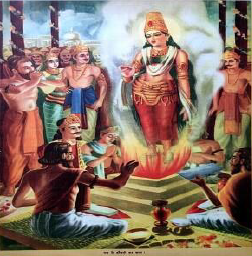
In the grand corridors of Panchala kingdom, Draupadi arises from the sacrificial fire, born to King Drupada as a gift of vengeance against Drona. This origin already sets her apart; she is not born for domesticity but for purpose. Her very existence challenges the norms of femininity in the epic.
The swayamvara is often cited as a symbol of Draupadi’s agency. She appears as the bride who may choose her husband. Yet, even this choice is framed within societal expectations. The contest is designed to attract Kshatriya warriors, and her father Drupada orchestrates it with the hope of securing Arjuna as his son-in-law. When Arjuna, disguised as a Brahmin, wins her hand, Draupadi accepts him, not purely from personal desire but in alignment with dharma and destiny. Thus, her autonomy, while present, is carefully contained within patriarchal structures.
Draupadi's marriage to all five Pandava brothers is perhaps one of the most debated episodes in the Mahabharata. The epic rationalizes it through past-life karma and Kunti’s mistaken command, yet Draupadi never resists this arrangement. She adjusts, adapts, and maintains a delicate balance among her five husbands. But her consent remains questionable, does she truly have a say? Historian Alf Hiltebeitel says that even though having multiple husbands is rare, it didn’t make her free. Instead, she had to play five different roles—each one asking her to stay quiet, give up things, and stay in control.
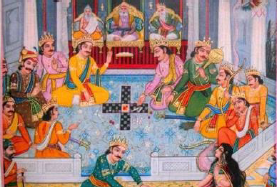
The sabha parva (Book of the Assembly Hall) brings Draupadi into focus. When Yudhishthira gambles away his kingdom, brothers, and finally Draupadi, she becomes a stake in a patriarchal game of pride and politics. Her reaction, however, is not silence. She demands clarity,she questions strī-svāmya (a woman being owned), she interrogates the dharma of kings, the silence of elders, and the complicity of institutions. In a hall filled with kings and sages, she alone speaks truth to power. Yet, despite her brilliance, she is dragged by the hair, insulted, and humiliated. Her agency is again overridden.
During the years of exile, Draupadi is not a passive queen mourning her fate. She is the emotional and ethical anchor of the Pandavas. She constantly reminds them of their duty to seek justice. Her anger, especially toward Bhima and Arjuna, is intense. She demands justice,not just for the kingdom lost but for her honor. However, her strength remains verbal, not martial. Draupadi cannot pick up arms; she must rely on her husbands. Her actions show courage and wisdom that go far beyond the boundaries placed on her as a woman. Still, those limits hold her back, even as her spirit rises above them.
Draupadi in the Mahabharata is full of contradictions. She's bold, intelligent, and unafraid to speak out even when men stay silent. Yet, unlike the male heroes, she can’t fight or take direct action. Her strength lies in her voice, memories, and pain. Through her, we see how dharma treats women differently. By the end of the epic, Draupadi slowly fades from the spotlight, becoming part of her husbands' story. But her powerful questions stay alive: Where do women stand in a world ruled by men? And what happens when justice fails them?
If Vyasa’s Mahabharata gives us a Draupadi shaped by dharma, duty, and royal restraint, the folk traditions of India offer us a Draupadi unchained, bold, unfiltered, and often divine. Across India’s diverse oral cultures, especially in Southern India, Rajasthan, and tribal belts like that of the Bhils, Draupadi is not a passive heroine but a fiery woman who commands, fights, and sometimes even curses the gods. These retellings found in folk epics, ballads, street theatre, and local temples reshape Draupadi as the people's queen: closer to their struggles, more emotional, and less restrained by elite codes of behavior.
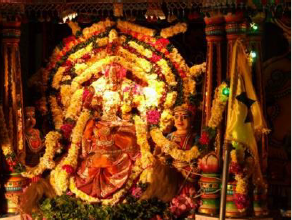
In Tamil Nadu and parts of Karnataka and Andhra Pradesh, Draupadi is not just remembered, she is worshipped especially by the Vanniyar community. In the Draupadi Amman cult, she is not a victim, but a protector who goes to the forest with the Pandavas in her strong form called “Virasakti.” There are also stories where Draupadi becomes wild in the forest, eating animals, until she hears the cries of magical children born from her, which brings out her motherly side. She is the central figure of village festivals like Terukkuttu and Draupadi Rath Yatra. Here, Draupadi is fierce and divine. In many temple legends, her hair remains untied until Dushasana’s blood touches it. She becomes a symbol of Shakti,female power and righteous rage. “I will not tie my hair,” she declares, “until I wash it with the blood of those who humiliated me.” This Draupadi doesn’t wait for Krishna to protect her, she is the protector. In folk theatre, she often appears as the force that drives the war, not as one waiting in the background. In some versions, she even rides into battle or performs rituals to ensure the Pandavas’ victory.
Among tribal communities like the Bhils of Madhya Pradesh and Rajasthan, Draupadi’s story reflects their own ideals of honor, freedom, and justice. In these versions, she is more earthy, emotional, and resistant to patriarchal expectations.One popular Bhil legend tells of a Draupadi who curses her husbands for not protecting her and goes into the forest alone. There, she gains magical powers and transforms into a powerful woman who can control elements and animals. Her voice is loud, her actions direct and unlike the Sanskrit version, she is not afraid to abandon the Pandavas when they fail her. This folk Draupadi isn’t bound by marriage or royal decorum. She represents the community’s sense of justice if wronged, she doesn't accept fate; she reshapes it.
In parts of Rajasthan, Draupadi appears in folk ballads and women’s songs, especially those sung during festivals or while doing household chores. These songs often use Draupadi’s story to express women’s pain, anger, and resistance. In these versions, she scolds the Pandavas, questions their masculinity, and directly blames Yudhishthira for her humiliation. Sometimes, she even threatens to leave them, saying. “What use are husbands who gamble away their wife?” These lyrics aren’t just entertainment—they’re subtle critiques of society. Through Draupadi, women express their frustrations with real-world inequality.
While Vyasa's Draupadi is a queen bound by codes of dharma, folk Draupadi is driven by raw emotion,anger, humiliation, pride, and love. She speaks more bluntly, she curses, she demands blood, and sometimes she acts outside dharma. In a sense, these versions give her the agency she lacked in the classical epic. She becomes: A goddess who protects the village. A warrior who curses and fights. A symbol of resistance for women. A figure of emotional justice, not just moral debate.
In today’s books, writers give Draupadi even more depth. A great example is Chitra Banerjee Divakaruni’s novel The Palace of Illusions, where Draupadi herself tells her story. In these modern versions: Draupadi questions the gods and her destiny. Her personal feelings, struggles, and dreams are explored in detail. She is no longer just a victim; she becomes the hero of her own story.
Draupadi’s journey across time is not just the story of one woman.It is the story of how societies remember, reshape, and reclaim female strength. In the classical Mahabharata, she is a queen whose voice dares to question injustice, even when ignored. In folk traditions, she becomes a goddess, a rebel, and a symbol of resistance,one who does not wait for justice but demands it. In modern retellings, she steps into the center of her own narrative, claiming the right to speak, feel, and act as a fully human protagonist.
What these shifting images reveal is profound: Draupadi is not a fixed character she is a mirror held up to each generation’s view of womanhood. Whether worshipped, sung about, or reimagined in novels, she continues to evolve, absorbing the hopes, pains, and questions of the people who tell her story. From fire-walker to truth-teller, from silent queen to fearless fighter, Draupadi remains one of mythology’s most enduring and powerful figures a reminder that women’s voices, once raised, echo far beyond the pages of epics.