Under the dappled shade of a thousand-year-old banyan tree in ancient Varanasi, three wandering sages gathered at dusk. The Ganga flowed quietly beside them, echoing timeless whispers.
One sage recited solemnly from Valmiki: “Rama, the righteous king, upheld Dharma—even as his heart shattered.”
The second sang from Kamban, voice heavy with emotion: “Rama, whose eyes glistened with tears, loved Sita with godly grace and human pain.”
The third, draped in rudraksha beads, smiled and invoked a mantra: “Jaya Jaya Devi! Sita, as Kali, rose when Rama fell silent.”
They debated all night—about kingship, justice, love, and illusion. At dawn, a quiet voice joined them. A veiled woman from the riverbank. “You ask what Rama did,” she said. “But ask too—what Sita became.” The sages fell silent. For in that one voice echoed the weight of centuries.
The Ramayana is far more than an epic. It is a cultural mirror, a moral compass, and a philosophical puzzle—rewritten and reimagined across centuries. While Valmiki’s Ramayana is considered the classical source, regional variants such as Kamban’s Tamil retelling and the lesser-known Adbhuta Ramayana offer radically differentmoral universes.
Each version responds to its time and space, remapping Dharma (moral order),heroism, and moral dilemmas through new narrative lenses. This essay explores howValmiki, Kamba, and Adbhuta Ramayanas interpret these three central themes,especially through the evolving character of Sita—a silent sufferer, a belovedgoddess, and finally, a cosmic warrior.
“There are many Ramayanas and many truths in each retelling.” –A.K. Ramanujan
| Theme | Valmiki Ramayana | Kamban Ramayana | Adbhuta Ramayana |
|---|---|---|---|
| Dharma | Hierarchical, duty-bound. Rajadharma over emotion | Bhakti-centered; Dharma is divine love and emotional grace | Cosmic Dharma; restored by Shakti’s intervention. |
| Heroism | Rama is ideal man and king. Heroism through restraint | Rama is divine and emotional. Heroism includes vulnerability. | Sita is the true hero; transforms into Kali and slays evil. |
| Moral Dilemma | Sita’s exile = necessary sacrifice for social order. | Rama’s inner pain is foregrounded; emotional conflict is ethical. | Rama fails; Sita faces the ultimate dilemma—to destroy evil herself. |
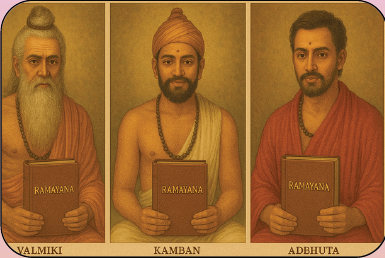
1. Valmiki’s Dharma: Duty Above All
In Valmiki’s Ramayana, Dharma is the immovable law that upholds society. Rama’sdecision to banish Sita after her trial by fire is not emotional, but deeply ideological:
“Desire must never override Dharma; only Dharma leads to happiness.”
Rama upholds Rajadharma (duty of a king) even when it causes personal suffering—revealing a vision of Dharma that is hierarchical, stoic, and often gendered.
2. Kamban’s Dharma: Love as Moral Light
Kamban, writing in 12th-century Bhakti-era Tamil Nadu, shifts the axis of Dharma fromlaw to love. Rama is no longer the stoic king but a god who feels deeply. His sorrow atseparating from Sita is not weakness but moral depth.
“Love is the lamp, Dharma is the flame—without love, Dharma is blind.”(Kamba Ramayanam, Ayodhya Kandam)
Here, Dharma is relational, flowing through devotion (Bhakti) rather than rules.
3. Adbhuta’s Dharma: Shakti Restores the Universe
In the Adbhuta Ramayana, Dharma is no longer bound to kingship or devotion—it iscosmic restoration, and only Sita as Mahashakti can enact it. When Rama is unable todefeat the thousand-headed Ravana’s brother, Sita transforms:
“I am time itself—the destroyer of darkness and Adharma.”
This is revolutionary: Sita becomes the warrior, Rama the witness. Dharma becomesfeminine and transformative.
In Valmiki’s text, Rama is the ideal man. Heroism is obedience—killing Ravana,giving up Sita, enduring loss. As historian Sheldon Pollock notes, Rama’s greatnesslies in “his moral stillness, not conquest.”
Kamban, however, reimagines Rama’s strength as feeling. Rama’s tears aresacred. His longing is divine. Heroism is not a sword, but a soul exposed.
Then comes the Adbhuta twist: Sita is the hero. She transforms into a 1000-armed Kali-like goddess, slays the unbeatable demon,and restores universal order. Heroism here is transcendence—divine, feminine, andfierce.
Dharma’s complexity is most vivid in each text’s treatment of ethical dilemmas. Valmiki’s Rama sacrifices Sita to protect his kingly image—upholding law, but atgreat emotional cost. Kamban’s Rama feels this conflict profoundly, showing the emotional toll of duty. In Adbhuta, Rama is morally paralyzed, and Sita must act. The moral burden shifts.
“Each Ramayana version is less about consistency and more about ethical conversation—between power, pain, and justice.” ~ Paula Richman
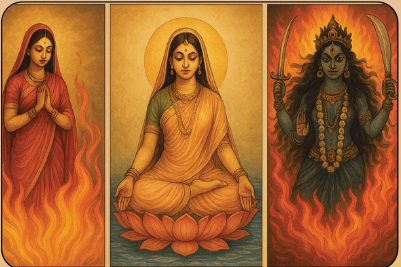
The Ramayana’s power lies in its plurality. It offers no single Dharma, but aspectrum of moral visions. It evolves with time, place, and culture.In Valmiki, Dharma is duty—even when painful. In Kamban, Dharma is love—even when conflicted. In Adbhuta, Dharma is transformation—even when radical. Together, they teach us that righteousness is not fixed—it is felt, fought, andsometimes, reborn in fire.
"सा शक्तिः या सीता”
That Power Is Sita Herself