The environment was a major factor in ancient India's socio-cultural and economic development. It was not a mere passive background, but nature in all its complexities, such as rivers, forests, mountains, climate, and soil, had a profound impact on the way societies evolved, economies prospered or declined, and how cultural and religious beliefs became. The life in ancient India flowed in harmony with its environment, telling an intricate story of human-environment interaction that is not just basic but also revolutionary.
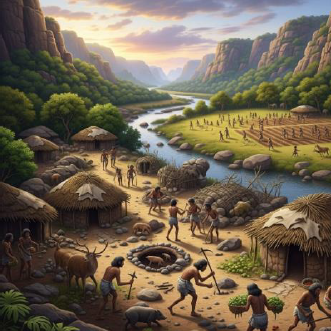
The primary record of mankind's habitation in the Indian subcontinent can be traced to the Palaeolithic period in which primitive humans living only by hunting and gathering. Their choice of dwelling places which were mainly river valleys, forest edges and hilly parts were dictated by the availability of water, game, and edible vegetation. The environment provided them not only with resources but also it influenced their nomadic patterns and simple social structures.
The arrival of the Neolithic era (around 7000 BCE) altered the economic and social landscape due to the domestication of animals and the beginning of settled cultivation, particularly in favourable environmental regions like the Indus and Ganges valleys. These places, full of fertile alluvial soil and fed by perennial rivers, provided fuel to the establishment of agrarian communities. There is no doubt that early civilizations in India appeared exactly in these ecological niches.
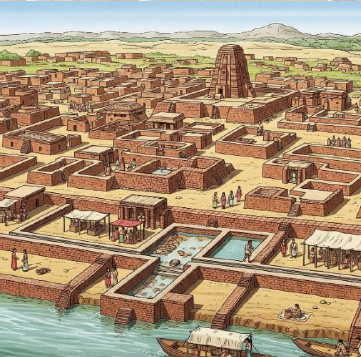
The Harappan or Indus Valley Civilization (approx. 2600–1900 BCE) is often called the first environment shaping civilization. Urban centres such as Mohenjo-daro and Harappa were riverbank settlements that took advantage of the river for water supply, irrigation, transportation, and trade. The abundance of resources, including fertile land and trade goods like semi-precious stones encouraged the rise of complex urban societies with diversified economies. The Harappans’ skills in hydraulic engineering, seen in the facilities of their drainage systems, wells, and reservoirs, shows how environmental problems were solved by utilizing innovation. On the other hand, the changes of the environment and the course of the river, in particular, the Ghaggar-Hakra (that is supposed to be the mythic Sarasvati), the reduction of the amount of rain, and the cutting down of the woods, may have been the main reasons for disappearance of this civilization. So, nature not only nurtured this civilization but also may be responsible for its downfall.
Post-Harappan cultures were the ones who took over and became familiar with the changing environment. The early Vedic period (about 1500–1000 BCE) was a time of semi-nomadic pastoralism centered on the Indo-Gangetic plains and the Sapta Sindhu. Pastoral tribes chose such ecologically rich areas that were most conducive to cattle rearing. With time, agriculture became the main economic activity, especially in the later Vedic period (1000–600 BCE) due to the clearance of forests and the availability of better iron tools for ploughing. This environmental transformation triggered surplus production, village life, and the varna system, which later turned into a rigid caste hierarchy. The relationship between land, climate, and occupational roles became embedded in social stratification.
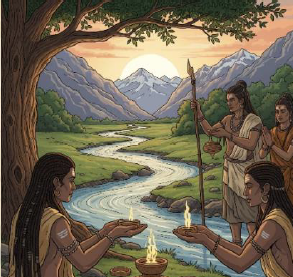
The environment's impact was far-reaching from various aspects and deeply penetrated the sphere of religious and philosophical thought. Rivers like the Ganges and Yamuna weren't just life-giving but also became deified, and thus, a major part of ritual and sacred geography. Forests, mountains, and natural elements received a lot of symbolic importance in religious texts - the Himalayas were regarded as the dwelling of gods, the forests as places of ascetic retreat(aranya), and trees were considered to be safe shelters of spirits. Rig Veda on environment says –
मधु वाता ऋतायते मधु क्षरतत तिन्ध्व। माध्वीर्न: िन्त्वोषधी:
मधु र्क्तमुतोषिो मधुमत्पातथनवंरज:। मधु द्यौरस्तु र्: तिता।।
मधुमान्नो वर्स्पततमनधुमााँ अस्तु िूयनः । माध्वीगऻवो भवन्तु र्ः ।।
(Environment provides bliss to people leading their life perfectly. Rivers bliss us with sacred water and provide us health, night, morning, vegetation. Sun bliss us with peaceful life. Our cows provide us milk.)
This ecological respect and admiration nurtured a culture that saw nature not just as a resource but as a being with spiritual powers. The Upanishadic and later Jain and Buddhist traditions that deeply held the principle of non-violence and renunciation, show the great respect for nature that was gained through living in forest hermitages and agrarian communities.
As political organizations changed, especially during the Mahajanapada and Mauryan periods (6th to 2nd century BCE), the economic and administrative systems were more and more connected to environmental management. The Mauryan Empire led by Ashoka (3rd century BCE) was an example of environmental governance that was very conscious of the natural world. Kautilya's Arthashastra talks about the significance of forests, mines, water bodies, and agricultural land in statecraft, and it also lists the different natural resources which are most important to royal revenue. Ashoka's inscriptions that are all about animal protection and tree planting are actually indicative of early policies with environmental consciousness. The empire's prosperity was linked to the fertility of the Gangetic plains and a well-regulated agrarian economy supported by irrigation and state oversight. Trade routes, often determined by river courses and passes through mountains, spurred urbanization and cultural exchanges.
During the post-Mauryan and early classical periods (circa 200 BCE–300 CE), the Satavahana and Kushana empires included, environment still affected trade, agriculture, and cultural synthesis. The semi-arid zones of the western Deccan witnessed the rise of tank irrigation systems to meet the needs of agriculture during this time. The economy based on the monsoon of that time called for water conservation technologies. Sea-port towns like Bharuch and Arikamedu fared well due to the coastal ecology, which was suitable for maritime trade, especially with Rome and Southeast Asia. At the same time, Buddhist monasteries, frequently positioned along the trade routes and in places ecologically advantageous, were not only the sources of the new culture but also the sustainable managers of the land and water resources around them.
The Gupta period (4th to 6th century CE), referred to as the “Golden Age” of India, was partially the result of exceptionally good weather and thriving agriculture in the fertile northern plains during those years. The environment made a surplus economy possible, which in exchange, underwrote the arts, literature, and science. Mathematical treatises, astronomical observations, and medical texts were often referring to natural phenomena as if the society was deeply engaged with its ecological reality. Pataliputra and Ujjain, were not only prosperous, but they depended on river-based commerce as well as on administrative efficiency in resource allocation. Unfortunately, environmental factors were also changing gradually, though not quite apparent. The land was being overused and it got degraded; deforestation was needed for extending the agricultural area and thus, the smaller rivers were drying up slowly, which caused local stress.
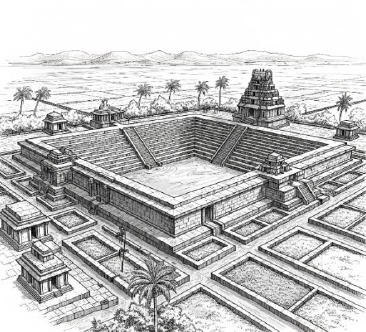
The regional kingdoms such as those of the Pushyabhutis, Vardhanas, and early Chalukyas came to the power in the post-Gupta period (6th to 8th century CE) when ecological landscapes were changing. The decentralization of power to local rulers and temple institutions resulted in them taking over greater roles in land management and irrigation. The temple thus became the center of religious, cultural, and agrarian life. These large-scale tanks, canal systems, and bunds are an environmental response to the challenges brought about by the variable rainfall and terrain. Land grants to Brahmins and temples (agraharas), often accompanied by descriptions of the fertility and topography of the land, are the record of the administrative importance of environmental knowledge. At the same time, ecological conditions decided the southward movement of political power and trade networks as rivers and coasts of peninsular India were growing in strategic and economic importance.
Throughout ancient Indian history, the environment has not only been the determinant of material conditions but a living and breathing entity, which has been inextricably bound with society’s deepest beliefs, economic systems, and political ideologies. It has been the main factor for the flourishing of civilizations, and at the same time, it has put limits and imposed the need for adaptive resilience.
From the hydraulic societies of the Harappans to the forest-dwelling rishis of the Vedic age, from the irrigated fields of the Maurya’s to the land grants of the post-Gupta kings, nature’s presence was everywhere…—it was shaping, leading, and sometimes, it was the one responsible for the downfall of the Human ambition. Understanding this complex interplay offers not only a lens into the past but also lessons for the present, where sustainability and environmental harmony are once again central to survival and progress.