When we think of religion in India, our minds often go to the grand and the glorious: towering temple spires reaching for the sky, priests performing elaborate rituals, or ancient scriptures filled with deep philosophy. These are indeed powerful symbols of Indian spirituality. But beyond the grandeur lies another, quieter path, a tradition that lives not in temples but in the heart of the home. Inside the everyday Indian household, religion takes on a softer, more intimate form. It lives in the early morning when a mother hums a sacred verse while sweeping the floor. It flickers gently in the flame of a diya lit at twilight. It rests in the small altar tucked into a kitchen corner, where gods sit beside spice jars and grains. Here, in these ordinary moments and spaces, the sacred becomes part of daily life.
Throughout India's long spiritual history, the home has never been just a shelter. It has always been a sacred space, a place where devotion is woven into the fabric of everyday living. The Sanskrit word grhastha (householder) is not just a stage of life but a spiritual responsibility. In this stage, faith is not something distant or dramatic; it is lived through cooking, cleaning, offering, and remembering. In the home, ritual becomes routine. Bhakti, or devotion, is not always loud or visible. It is often silent and continuous, flowing like breath itself. It is in the act of applying a tilak before stepping out, placing flowers before a deity, or pausing for a moment of gratitude before meals. These micro rituals may seem small, but they hold deep meaning. They remind us that divinity does not only live in temples. It also lives among pots and pans, in gestures of love, in daily duties done with care. Thus, the Indian household is not separate from the sacred. It is sacred. It is here that devotion becomes personal, spiritual practice becomes part of life, and the divine feels close, gentle, familiar, and always near.
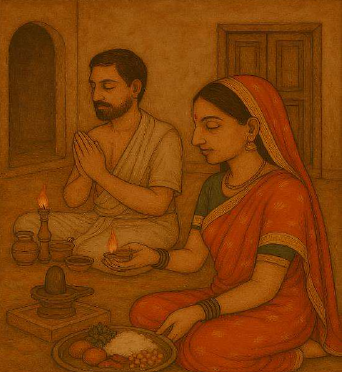
In the Indian tradition, the home is not just a place to live; it is a sacred space where everyday life and spiritual practice blend seamlessly. The stage of the householder, known as grihastha, is far from being seen as merely worldly or material. In fact, the Dharmasastra texts place the grihastha at the very heart of society's spiritual structure. The Manusmrati (Chapter 6, Verse 89) clearly states that the householder upholds the other three stages of life: brahmacharya (student), vanaprastha (forest dweller), and sannyasa (renunciate). It is through the householder's practice of hospitality, ritual offerings, and moral living that the wheels of dharma continue to turn. Ancient Indian texts such as the Grihyasutras, domestic manuals like the Asvalayana and Baudhayana Grihyasutras, dating back to the first millennium BCE, offer detailed instructions on how household rituals were to be performed. These included sacred duties such as the agnihotra (daily fire offering). sandhyavandanam (twilight prayers), and pitr tarpana (offerings to ancestors). Such practices were not seen as optional or decorative; they were essential threads in the fabric of everyday life, ensuring the home remained aligned with cosmic and ethical order. These rituals were marked by a precise sense of timing, purity, and symbolism. Even the smallest act, like offering a few drops of water to the sun or maintaining the sacred kitchen fire, was filled with spiritual intention. In the Satapatha Brahmana, the domestic fire itself is described as sacred. It is not merely a source of heat for cooking but a continuation of the great Vedic fire rituals, linking the home directly to the larger cosmic sacrifice. Thus, the Indian home was never just a physical shelter. It was a living altar, a place where the sacred entered quietly cach day through fire, water, food, prayer, and remembrance. The grihastha was not only a provider or protector of the family but also a priest of the household, keeping alive the rhythm of ritual and the pulse of devotion.
In many Indian homes, especially in traditional settings, one can often find a graceful plant growing in the courtyard, sometimes on a raised platform or in an ornate enclosure. This is the Tulsi plant, revered not just for its fragrance or medicinal value, but as a sacred presence in the household. Although the earliest Vedic texts do not mention Tulsi, her importance grows significantly in later sacred literature. It is in the Puranas, such as the Padma Purana, Skanda Purana, and Devi Bhagavata Purana, that Tulsi emerges as a sacred figure. She is not only linked with the goddess Lakshmi but is also considered beloved to Lord Vishnu. In these stories, Tulsi is more than a plant. She is a living goddess, a symbol of purity, devotion, and protection. By the medieval period, particularly during the rise of the Bhakti movements, Tulsi's role in domestic worship becomes deeply rooted in Vaishnava tradition. The ceremony known as Tulsi Vivah, where Tulsi is symbolically married to Vishnu, marks the beginning of the spiritual wedding season. This ritual is still performed in many parts of India today, often with music, lamps, and offerings, reinforcing her role as both a divine presence and a member of the household. Archaeological and ethnographic evidence from regions like Gujarat, Bengal, and Tamil Nadu shows how central Tulsi has been in courtyard worship. Beautifully carved Tulsi Vrindavans, made of stone or brick, are often found in traditional homes. These structures are not mere planters. They are sacred platforms, often decorated with lotus motifs, arches, and miniature shrines. They serve as daily sites of worship, where women light lamps, offer water, and recite prayers. In this way, Tulsi becomes more than a plant. She is a silent guardian of the threshold, a daily witness to devotion, and a living link between the household and the divine.
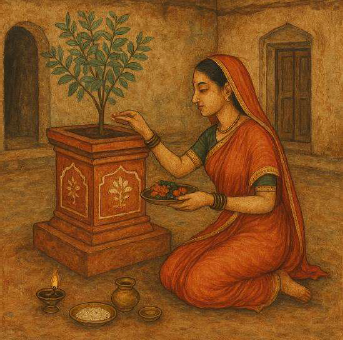
The act of lighting a lamp at twilight is one of the most ancient and deeply symbolic rituals in Indian spiritual life. As the day fades into evening and shadows begin to lengthen, the gentle glow of the lamp offers more than just light,it becomes a prayer, a gesture of reverence, and a way to welcome the divine into the home. This sacred moment finds its earliest echoes in the Rigveda, in the Ratri Sukta, where night itself is praised as a goddess who shelters and protects. The Brhadaranyaka Upanisad concludes with a timeless prayer tamaso ma jyotir gamaya "lead me from darkness to light." These lines remind us that lighting a lamp is not just a physical act, but a spiritual journey, an offering of hope and clarity in a world filled with uncertainty. The Grihyasutras, ancient manuals of household rites, identify twilight sandhya as a liminal time, when day gives way to night and the world briefly pauses. This is the hour for sandhyavandanam, a ritual of meditative chanting, offering water, and invoking inner purity. It is during this time that the first flame is often lit, transforming the home into a space of sacred presence. Over centuries, this quiet practice evolved into the Deepa Puja, or lamp worship, especially cherished in South Indian homes. Here, the lamp itself is treated as a deity. Women offer flowers, turmeric, kumkum, and sing bymns to the glowing flame, asking for prosperity, protection, and peace. The lamp becomes a symbol of Lakshmi, of Saraswati, of the goddess in her radiant form. Inscriptions from the Chola period, particularly between the tenth and twelfth centuries, mention the royal provision of ghee for evening lamps. These records are found not only in connection with temples but also with Brahmin households. This suggests that the act of lighting a lamp at dusk held sacred meaning in both public and private spaces. The glow of the flame was believed to sustain divine presence not just in the temple sanctum but also in the intimate world of the home. In this quiet ritual, passed down through generations, we see how Indian spirituality lives through light. Each evening, as the lamp is lit, it is not merely a custom but a communion with ancestors, with gods, and with the inner self that seeks to walk from darkness into light.
In Indian thought, food is never just a necessity it is sacred. The Taittiriya Upanishad declares boldly: Annam Brahma, "Food is Brahma." This simple yet profound statement captures the deep reverence for food in Indian culture. Cooking, offering, and eating are not seen as mere domestic tasks. They are acts of devotion, intimately woven into the spiritual rhythm of the household. Before any meal is consumed, a portion is often offered to the divine. This practice, called Naivedya, is prescribed in the Smriti texts and continues to be performed in countless homes across India. In this gesture, food becomes a bridge between the human and the divine. The hearth becomes an altar, and the meal becomes prasada blessed sustenance that carries grace. The Sankhyayana Grihyasutra advises the householder to offer the first handful of freshly cooked rice to Agni, the fire god. This ancient ritual honors fire not only as the physical flame that cooks the food but also as the divine witness of sacrifice. Even today, echoes of this practice live on in rural traditions. In many villages, the first roti is placed aside for the cow gau gras and the last for the stray dog. These simple offerings, often made without fanfare, reflect a worldview where devotion, ecology, and compassion are deeply interconnected.
Rituals extend beyond the kitchen into the very threshold of the home. In Tamil Nadu, women wake at dawn to draw kolam, intricate rice flour designs, on the ground outside the entrance. In Bengal, these are known as alpana, often made with rice paste. Though beautiful to look at, these patterns are more than decoration. They are acts of ritual drawing, invoking prosperity and welcoming goddess Lakshmi into the home. Passed down through oral traditions and regional sastra manuals, these designs represent both aesthetic expression and spiritual intention. In these small yet profound gestures offering a portion of food, feeding animals, drawing sacred patterns the Indian home transforms everyday tasks into sacred acts. The kitchen, courtyard, and doorstep all become places where devotion quietly unfolds, reminding us that the divine is not far away, but present in every act done with love, care, and reverence.
In the sacred space of the Indian home, the presence of the grihini, the householder's wife, is not passive or secondary. She is not merely a participant in ritual life, but often its central agent and guardian. The ancient legal and ritual texts, such as the Parasara Smriti and the Katayana Smriti, underline her vital role in maintaining household purity, performing daily offerings, and upholding the sacred order of the home. Her devotion is expressed most vividly through the observance of vratas ritual vows and fasts performed with intention, discipline, and deep emotional power. These rituals, though varying by region, are bound by a shared spirit of feminine strength and spiritual responsibility. In North India, Karva Chauth is observed by married women who fast for the well-being of their husbands. In Maharashtra, Vata Savitri honors the legendary devotion of Savitri, who defied death itself through her faith. In Tamil Nadu, Aadi Perukku celebrates fertility, prosperity, and the life-giving force of rivers. In many regions, Ahoi Ashtami is observed by mothers who fast and pray for the health and longevity of their children. These vratas are not only rituals of devotion but also expressions of inner resolve, creative ritual artistry, and quiet spiritual agency. They are often performed without priestly mediation, passed down through generations of women who preserve chants, stories, gestures, and customs through memory and practice. Anthropologist Leela Dube, in her influential work Women and Kinship (1997), shows how such rituals give women a distinct spiritual authority within the domestic sphere. Through these acts, women do not merely uphold dharma, they interpret it, embody it, and transmit it. They shape the rhythm of household worship, sanctify food and space, and act as intermediaries between generations and the divine. In the hands of the grihini, the home becomes a temple in its own right, where her daily acts such as lighting the lamp, observing fasts, offering water, reciting stories, are woven into the very fabric of family and faith. Her quiet strength and spiritual dedication ensure that the sacred continues to live not only in texts and temples, but in the everyday life of the home.
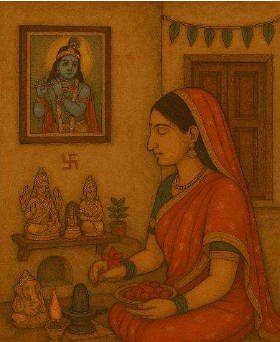
In the Indian household, the divine is not distant or abstract. It lives close,on the walls, in small niches, above doorways, beside the kitchen stove. Domestic iconography, the way sacred images and symbols are placed and honored in the home, reveals a world where gods and goddesses are not just worshipped but welcomed as members of the family. Unlike the grandeur of temple sculptures or the formality of public shrines, the images in the home are intimate and personal. A framed print of Krishna playing the flute, a small clay Ganesha by the entrance, a brass Lakshmi idol on a shelf, or a simple Shiva linga nestled beside tulsi, all these are part of a visual language of devotion. These images are not random decorations. They are carefully chosen, ritually placed, and emotionally held. The domestic altar, or puja sthana, may be a wooden cabinet, a small wall shelf, or even a corner of the kitchen. It often holds icons of Vishnu, Shiva, Lakshmi, Durga, or family deities (kuladevatas), along with incense holders, bells, and tiny oil lamps. In many homes, ancestors too are remembered, photographs garlanded and placed beside the gods, showing how the sacred and the familial coexist. Iconography also extends beyond the altar. The toran hung above the door, made of mango leaves or fabric, protects and blesses the threshold. Symbols like the swastika, shankha, and padma (lotus) are drawn or painted near the doorway or kitchen, invoking auspiciousness. In Bengal, clay figures of Lakshmi and Saraswati are shaped anew during autumn festivals. In Gujarat, decorative wall hangings called bandhanwar are embroidered with mythic motifs, while in Kerala, images of Krishna as a child (Unni Krishnan) are often placed in cradles during Janmashtami. These images do more than represent divinity, they invite it in. They mark time and season, mood and memory. During Diwali, Lakshmi images are freshly installed and bathed in light. During Navratri, dolls and icons are displayed in colorful tiers (golu), turning the home into a narrative landscape of gods, goddesses, sages, and animals. This domestic iconography is not static. It evolves with family histories, regional styles, devotional moods, and life events. A child's naming may bring a new Krishna idol; a pilgrimage may add a stone from a sacred river, a marriage may expand the altar with a new household deity. In this way, the home becomes a dynamic, sacred museum, filled not with relics, but with living presences. Here, the sacred is not just seen. It is lived, touched, sung to, and remembered. The images on the wall are not silent, they speak to the soul of the house, reminding its people every day that divinity is not far away, but part of the family, resting in the heart of the home.
The story of Indian spirituality is not complete without the small, luminous acts performed within the household: a lamp lit at twilight, a tulsi watered at dawn, a whisper of mantra over food. These micro-rituals are living histories-passed down not through inscriptions or temples, but through the muscle memory of mothers, grandmothers, and caretakers. In an age of fast modernity and digital life, these rituals remain silent archives of the sacred, preserving the essence of dharma not in stone, but in the smoke of incense curling through a kitchen window.